What Physiological Factors May Contribute to an Older Adult Who Has Cancer
Lab work
Finding well-being where cancer and crumbling meet
The Psycho-Oncology in Aging and Cancer Laboratory at Memorial Sloan Kettering Cancer Center focuses on the unique needs of older adults with cancer
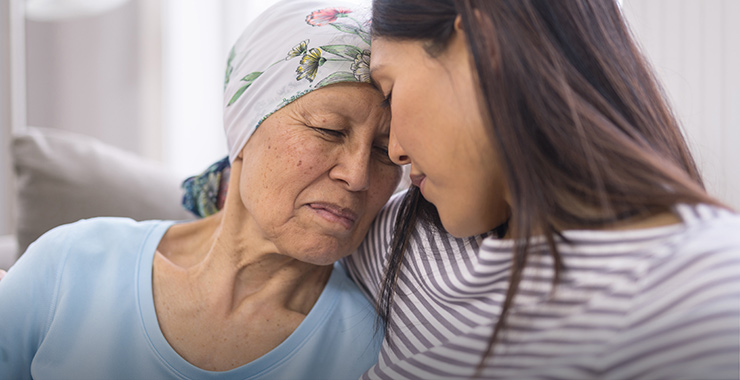
Age is the single most important risk cistron for cancer, but older adults with cancer can be a challenging research population. People in their 60s, 70s, and beyond are more likely to take multiple wellness problems, including physical disease and cerebral impairments. "Older adults with comorbidities are oft screened out of research," said Kelly Trevino, PhD, codirector of the Psycho-Oncology in Aging and Cancer Laboratory at Memorial Sloan Kettering Cancer Center (PAC MSK) and an associate attending psychologist in the center'southward Department of Psychiatry and Behavioral Sciences.
For Trevino and her colleagues, the complex physical and psychosocial factors affecting older adults with cancer aren't beside the point. They are the point. The lab'due south mission: Identify and accost the unique psychosocial needs of older adults with cancer, every bit well as those of their loved ones and caregivers. "The problems facing older adults with cancer cantankerous disciplines, so we take a collaborative arroyo to make sure our clinical intendance meets the comprehensive needs of these patients," Trevino said.
PAC MSK includes psychologists, psychiatrists, social workers, nurses, and health communications researchers—a well-oiled and influential team that won the 2020 APA Prize for Interdisciplinary Squad Inquiry. The lab was the abstraction of the tardily psychiatrist Jimmie Holland, MD, a founder of the field of psycho-oncology. The subject field focuses on how people react to life-threatening diagnoses and the challenges of handling—and how best to support them during that period of their lives. Holland devoted her career to addressing the psychological needs of cancer patients and cancer survivors, cofounding the International Psycho-Oncology Society, the American Psychosocial Oncology Society, and the journal Psycho-Oncology. She passed away in 2017 at age 89, simply her vision lives on in PAC MSK.
"When Dr. Kingdom of the netherlands started the field of psycho-oncology, there really wasn't any attention being paid to the psychosocial needs of cancer patients," Trevino said. "The landscape is vastly dissimilar at present."
Despite keen strides, at that place is still much to learn about the unique needs of older adults with cancer. "That's a guiding force for u.s.a.," said Christian Nelson, PhD, codirector of PAC MSK and chief of psychiatry in Memorial Sloan Kettering's Department of Psychiatry and Behavioral Sciences. "Whether it'south thinking about the best ways to diagnose depression or provide psychotherapy to older adults with cancer, or helping clinicians better appoint with patients, our overall goal is to provide the all-time psycho-oncology care possible to older cancer patients."
Taking aim at depression and anxiety
The netherlands'south enquiry focused broadly on the needs of cancer patients. But over time, she became increasingly interested in the unique needs of older adults—not only because she recognized that cancer is largely a disease of crumbling only also because she herself was growing older, Nelson said. PAC MSK officially launched in 2005 with back up from the Silbermann Foundation, which has connected to provide funding as the lab has matured. What started as weekly brainstorming luncheon meetings presently grew into support groups for older cancer patients, which continue to this day. Over the years, the lab also honed its research focus.
"From the beginning, we were interested in integrating developmental themes into psychotherapy for older adults with cancer," Nelson said. "These are concepts such as wisdom and mentorship, how to give back and pass on what y'all've learned to the younger generation, looking back at your life in review, and the idea of facing decease equally yous're even so living."
Integrating those themes into psychotherapy, the PAC MSK team created the Cancer and Crumbling: Reflections for Elders (CARE) model, a telephone-based intervention to reduce depression, feet, and distress related to cancer diagnosis and handling in older patients. In a pilot study, the intervention proved feasible and showed promising trends in reducing depression and anxiety among the participants, who were all over seventy and had been diagnosed with cancer at to the lowest degree six months prior (Nelson, C. J., et al., Psycho-Oncology , Vol. 28, No. ane, 2019). With funding from the National Cancer Plant, the squad is now leading a larger randomized controlled study of the intervention.
Rebecca Saracino, PhD, an assistant attending psychologist at Memorial Sloan Kettering, has worked closely with Nelson to written report interventions for depression as well as approaches to refine depression diagnoses in the context of cancer and aging. She received a 2015 APA Dissertation Research Award for the work, which she began as a young man at PAC MSK and has continued after officially joining the team as a faculty member. Physical symptoms of depression such as fatigue, sleep disturbances, and loss of appetite tin overlap with cancer treatment side effects, so they may non exist as useful for identifying depression in cancer patients.
Culling criteria for diagnosing depression in older cancer patients, proposed by psychologist Jean Endicott, PhD, of Columbia University, in the 1980s—including tearfulness or depressed appearance, social withdrawal, self-pity or pessimism, and an inability to be cheered up by good news or funny situations—may be more useful, Saracino and colleagues establish (Psychological Assessment, Vol. 32, No. 1, 2020). "Overall, we've found that concrete symptoms aren't reliable indicators for diagnosing depression in older adults in the cancer setting," Saracino said. "We demand to look toward more alternative criteria, including boosted cognitive and affective symptoms."
Saracino is likewise launching a new study of behavioral activation in older adult cancer survivors with depression, with funding from the National Cancer Institute. Behavioral activation, which aims to increment people's contact with rewards by helping them engage in positive experiences and social activities, is a key piece of many depression interventions. But scheduling meaningful and enjoyable activities can be challenging in a population of older adults who may have poor wellness or limited mobility. Saracino'south written report will explore whether researchers can tailor behavioral activation interventions to the physical and cognitive condition of older adults with a history of cancer. "Nosotros know they are at risk for depression, and they may take lost their social connections or stopped doing things they once enjoyed," she said. "We accept this testify-based handling. Let's make sure we can deploy information technology effectively to reach our patients."
Trevino, meanwhile, is taking aim at feet. With funding from the National Institute on Aging, she and her colleagues adult an anxiety intervention for older adults with cancer and their caregivers. The cognitive behavioral therapy–based intervention, delivered past social workers over the telephone, was modified to help older adults draw on their values and lived experiences. "In the offset session, the therapist works with older adults to identify what is important to them, how those things have changed over time, and the areas of force or expertise they've developed over their lifetime," Trevino said. "Throughout the intervention, the therapist taps into that life experience and works with them to find ways to apply those strengths to managing their anxiety."
Patients' caregivers frequently feel feet every bit well, including worries about what the futurity holds and whether they are doing enough to care for their loved one. Trevino's intervention too included 1-on-ane telephone sessions with caregivers to address those concerns in a confidential infinite, without the care recipient present. The initial airplane pilot study suggested the intervention was associated with reductions in feet in patients, and fifty-fifty larger reductions in caregivers (Periodical of Geriatric Oncology, Vol. eleven, No. viii, 2020). "Information technology was a modest report, simply promising. We're hoping to get funding for a larger trial to more closely examine the furnishings and also to take a closer wait at the intervention for caregivers," Trevino said.
Improving communication
While most of the lab's inquiry focuses on the experience of patients and caregivers, the squad is also interested in helping clinicians improve the way they recall well-nigh and interact with older adult patients. Since 2005, Memorial Sloan Kettering'due south Communications Skills Grooming Program and Enquiry Laboratory (Comskil) has developed trainings for wellness intendance providers on a diverseness of topics, based on clinical demand. For several years, Comskil and PAC MSK have collaborated to develop trainings to improve providers' ability to communicate with older adult patients and their caregivers—skills that are often defective in health intendance training. "Many of our participants say they've had no specific training for working with older adult patients," said Patricia Parker, PhD, a psychologist and managing director of Comskil.
She's leading a project to written report a training program for providers including oncologists, primary care physicians, nurses, psychologists, social workers, and physical and occupational therapists. The ii-day program aims to help providers better appraise patients for cognitive damage and communicate more finer with patients and their caregivers. For example, participants acquire skills related to recognizing ageism and geriatric syndromes, improving communication with patients who accept functional or sensory impairments, and ensuring that both patient and caregiver are included in discussions. "This provides an opportunity to introduce providers to ideas they oasis't thought about and teaches them concrete skills they tin can use when working with older adults," Parker said.
The Comskil model follows a predictable process, said behavioral scientist Smita Banerjee, PhD, a Comskil kinesthesia member whose piece of work focuses on wellness advice. The researchers have a deep swoop into the literature, develop a training model based on the research, and test it with providers. If it seems promising, they follow up with a larger study to evaluate its effectiveness, offer the grooming to providers both within and exterior the Memorial Sloan Kettering arrangement. With colleagues from the geriatrics division, Banerjee developed and tested a geriatrics-focused training programme to ameliorate verbal and nonverbal communication between oncology care providers, older developed patients, and their caregivers. The training involves didactic learning modules as well as hands-on practice communicating with patient-actors. In one role-play scenario, for instance, clinicians do speaking with an 85-year-old patient with colon cancer and the patient'south developed kid caregiver, who is worried most the parent'south weight loss, weakness, and ability to continue living lone. In another, the provider practices a difficult conversation with a patient who wishes to discontinue cancer treatment and the patient's adult child, who is unwilling to have that option.
The results are not yet published, just Banerjee said participants showed improvement in their communication skills. Participants were more likely to inquire patients for permission to include caregivers in the conversation and to connect patients with additional resources and referrals. The participants besides rated the training positively, reporting significant improvements in feelings of self-conviction and self-efficacy. "In a busy clinical setting, clinicians don't often have time to stop and reverberate on what went well and what didn't," Parker said. "What really differentiates our trainings is the experiential component and the opportunity for firsthand feedback from the facilitators, from colleagues, and from the actors themselves."
Leaders in squad research
The core PAC MSK team includes nine faculty and 5 research staff members. The faculty members all have dual roles as clinicians and researchers—experience that closely informs the lab'southward mission. "Considering we are as well clinicians, nosotros're all very aware of the day-to-24-hour interval struggles our patients are having," said Saracino. "When someone discusses a new idea or a new project, it resonates because many of united states take seen the same matter in our clinical do."
Working with older adults with cancer requires flexibility. "The people in our written report samples are sick, and many of them are going through toxic treatments. Their lives accept been significantly disrupted," said Trevino. "That creates challenges for recruitment, but it also means we accept to be specially sensitive to our participants' needs. At the finish of the day, nosotros're focused on patient care."
The lab faculty and their collaborators come from psychology, psychiatry, nursing, oncology, geriatrics, social work, and health advice backgrounds. That commitment to collaboration—and the scientific contributions that were born from the teamwork—is what earned the lab APA'southward interdisciplinary research prize last twelvemonth. The involvement in collaboration dates back to Holland, who was known to accept an open-door policy for clinicians and researchers from any department, Saracino said. "Our lab perpetuates that by welcoming people from disciplines across the infirmary and having new voices represented," she said. "Nosotros accept a team that's nonjudgmental and receptive to getting feedback. To exercise interdisciplinary work, you demand to be humble enough to recognize you have a lot to acquire."
Indeed, Trevino added, almost all psychologists would benefit from being open up to learning more than near the unique needs of older adults. "The population is getting older, and most of the people working in psychology will interface with older adults in some mode," she said. "There are so many myths about older adults. There's a real benefit for psychologists to proceeds noesis of developed evolution and the unique issues facing this population."
Farther reading
Identification and treatment of depressive disorders in older adults with cancer
Saracino, R. M., & Nelson, C. J., Journal of Geriatric Oncology, 2019
Symptomatology, assessment, and handling of anxiety in older adults with cancer
Trevino, K. Chiliad., et al., Periodical of Geriatric Oncology, 2021
Addressing communication challenges in older patients with cancer and geriatric syndromes: A advice skills training module for health care providers
Alexander, One thousand., et al., European Geriatric Medicine, 2019
Addressing the quality of communication with older cancer patients with cognitive deficits: Development of a communication skills grooming module
Korc-Grodzicki, B., et al., Palliative & Supportive Care, 2020
Recommended Reading



Members may qualify for lower pricing
Research foci
The Psycho-Oncology in Aging and Cancer Laboratory is:
- Studying the assessment of distress in older adults with cancer
- Developing interventions to care for depression and feet in older patients with cancer and their caregivers
- Developing training programs to amend health care providers' communication skills relating to older adult cancer patients
Contact APA
wilkersonluche1938.blogspot.com
Source: https://www.apa.org/monitor/2021/07/lab-cancer-aging
0 Response to "What Physiological Factors May Contribute to an Older Adult Who Has Cancer"
ارسال یک نظر